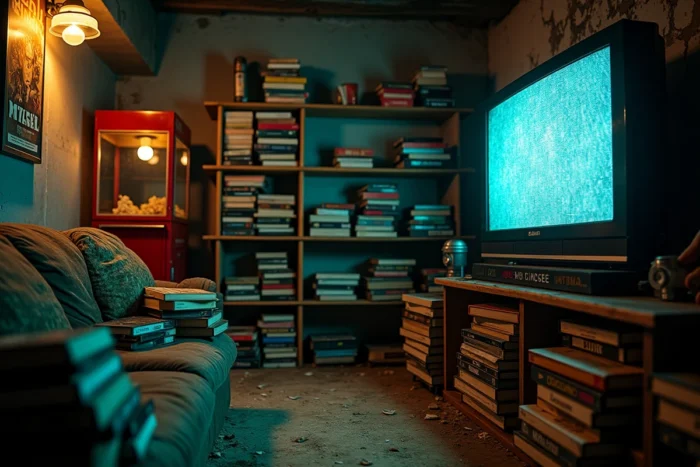
The boundary between B-movies and Z-movies is not just a question of budget. It involves radically different production, distribution, and reception logics, which film critics have long blurred by grouping everything under the convenient label of “cult cinema.”
B-Movie Economics: The Hollywood Double Feature Model
The term B-movie refers to a specific distribution circuit, that of the double feature in American theaters from the 1930s to the 1950s. The A-movie was the main attraction, while the B-movie filled the screening at a lower cost. This system was based on a contract between studios and exhibitors, not on a judgment of quality.
Filmmakers like Edgar G. Ulmer and Jacques Tourneur worked within this framework under tight shooting constraints, often just a few days on set and recycled sets. We observe that this economy of means has generated lasting aesthetic choices: expressionistic lighting compensating for the lack of sets, elliptical editing masking impossible cuts, and the use of off-screen space to avoid costly special effects.
Roger Corman extended this logic well beyond the disappearance of the double feature by founding an independent production model where the film had to be profitable from its first release. James Cameron actually honed his skills as an art director on Galaxy of Terror (1981) produced by Corman, before directing Aliens five years later. This journey illustrates how B-movies have functioned as a laboratory for Hollywood genre cinema.
A catalog dedicated to this universe is available at https://www.serie-z.fr/, which lists both classic film noir and low-budget science fiction productions.
Z-Movies and Amateur Cinema: When DIY Becomes an Aesthetic Gesture
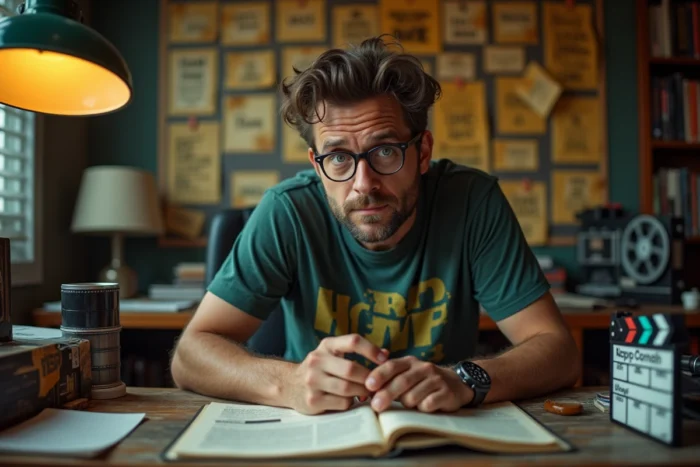
Z-movies do not simply refer to films that are even more low-budget than B-movies. They imply a break with the minimal technical standards of professional production: untrained actors, absence of a finalized script, special effects cobbled together with household materials. The result escapes the evaluation grids of conventional cinema.
Ed Wood remains the iconic figure of this cinema, not for the technical shortcomings of Plan 9 from Outer Space, but because he embodied a sincerity of approach that was completely disconnected from industrial standards. The Z-movie embraces accidents, continuity errors, and shaky sets.
With the rise of the Internet from the 2000s onwards, some amateur filmmakers and online communities have explicitly claimed the Z-movie label as a marker of counter-culture. DIY and bad taste have become conscious aesthetic choices rather than mere technical flaws. Forums like DevilDead have documented this evolution, where the label functions as an anti-industrial gesture, on the fringes of the major studios.
Distinctive Criteria of Z Production
- The absence of a professional distribution circuit: the film circulates on VHS, burned DVD, or amateur streaming, never in theaters
- The systematic use of shooting in unmodified natural settings, often the director’s garden or garage
- A cast made up of friends, without formal direction, resulting in a recognizable offbeat performance
- Handmade special effects (ketchup for blood, cardboard models for monsters) that contribute to the charm of the genre
Genre Fiction and B-Movies: Science Fiction, Film Noir, Horror
B-movies are not a genre in themselves. They traverse science fiction, film noir, war films, and horror. What characterizes them is an unrestrained relationship with narrative codes. Where A-movies hide their strings, B-movies flaunt their conventions with an energy that compensates for the lack of resources.
The monster movie of the 1950s perfectly illustrates this mechanism. The rubber creature visible on screen does not break the pact with the viewer; it renegotiates it. The drive-in audience came looking for a direct sensory experience, not a perfect illusion.
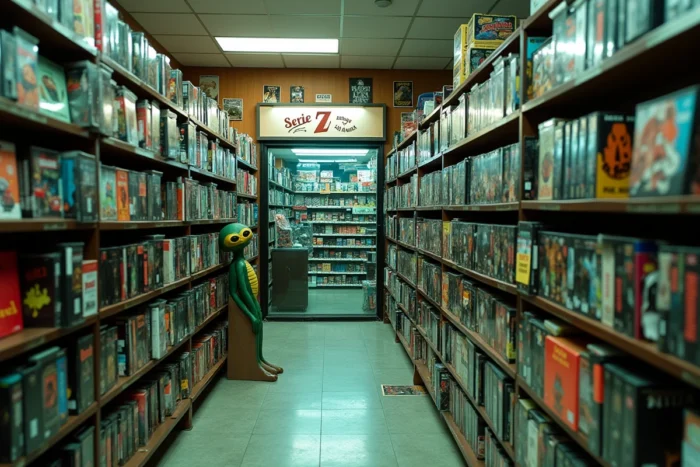
In science fiction, B-movies explored themes that major studios deemed too commercially risky. Nuclear paranoia, alien invasion as a political metaphor, genetic mutation: these subjects found an expressive space in low-budget cinema that Hollywood did not offer them.
Contemporary Legacy: From Embraced Bad Movies to Nostalgic Blockbusters
Today, we observe two parallel trajectories. On one side, the world of bad movies cultivates an ironic and communal reception. Specialized sites like Nanarland have structured a critical discourse around these films, with their own vocabulary and evaluation criteria. A bad movie is not a failed film; it is a film whose failure produces a specific pleasure.
On the other hand, the Hollywood industry extensively recycles the codes of B-movies. Giant monster franchises, disaster films with digital effects, micro-budget horror productions revive narrative patterns forged in the independent studios of the 1950s and 1960s.
- The post-Jaws shark film has spawned dozens of embraced Z variations, some of which have become viral phenomena
- The micro-budget slasher perpetuates the economic model of the B-movie with profit margins sometimes exceeding those of blockbusters
- Found footage has reinvented technical DIY as a marketing argument, transforming constraint into a selling point
B-movie and Z-movie cinema is not an anecdotal margin of film history. It forms an underground backbone, where narrative forms and visual conventions are tested before they permeate mainstream production. Understanding this circuit is to understand how the real economy of genre fiction operates.