
Choosing chips for an appetizer means comparing what is actually in the bag, not what’s on the packaging. Salt, saturated fats, Nutri-Score, additives: these four indicators create very different rankings from one product to another. The type of chips (potato, legumes, vegetables) is not enough to predict nutritional quality. Only the precise product profile can make the distinction.
Salt and saturated fats in chips: the table that changes the reading
The comparisons published by 60 Millions de consommateurs and the Swiss FRC provide concrete benchmarks. Salt remains the most discriminating marker among the common references in the French market.
| Type of chips | Salt (g/100 g) | Saturated fats | Nutri-Score | Additives |
|---|---|---|---|---|
| Classic potato (e.g., Zweifel nature) | 1.2 | High | C | Low level |
| Light potato | Often less than 1.2 | Reduced | B (best case) | Low level |
| Alternatives (peas, lentils, rice) | Up to 3.1 | Variable | B to D depending on the brand | Often higher |
| Brown Rice chips salted (Aldi) | 0.9 | Moderate | Variable | Variable |
The first observation: some legume chips far exceed the salt content of classic chips. A product based on peas or rice can show more than double the salt content of a plain potato chip. The category guarantees nothing.
Identifying the healthiest chips therefore requires reading each label rather than relying on the marketing positioning of the aisle.
Baked chips and olive oil: marketing promises and real limits
The label “baked” suggests a product that is significantly less fatty. Several products of this type indeed achieve a Nutri-Score B and decent ratings on Yuka. The reduction in fat is measurable compared to traditional frying.
The problem lies elsewhere. Baked chips remain highly salted in many cases, and the ingredient list may include additives that baking does not eliminate. The caloric gain does not always compensate for excess salt or the presence of artificial flavors.
Chips made with olive oil follow the same logic. Olive oil provides a more interesting lipid profile (more monounsaturated fatty acids), but the amount of oil absorbed during frying remains comparable to that of sunflower oil. The type of oil changes the fat profile, not the total amount.
What the Nutri-Score does not capture
The Nutri-Score synthesizes salt, sugars, saturated fats, fiber, protein, and fruits/vegetables into an overall score. It does not take into account acrylamide, a substance that forms during the high-temperature cooking of starchy foods. This compound, classified as a probable carcinogen, is absent from traditional nutritional comparisons.
Two chips rated B on the Nutri-Score can contain very different levels of acrylamide depending on the temperature and cooking time. This criterion escapes the consumer in the aisle, as no labeling mandates it.
Legume chips and vegetable chips: sorting the true from the false
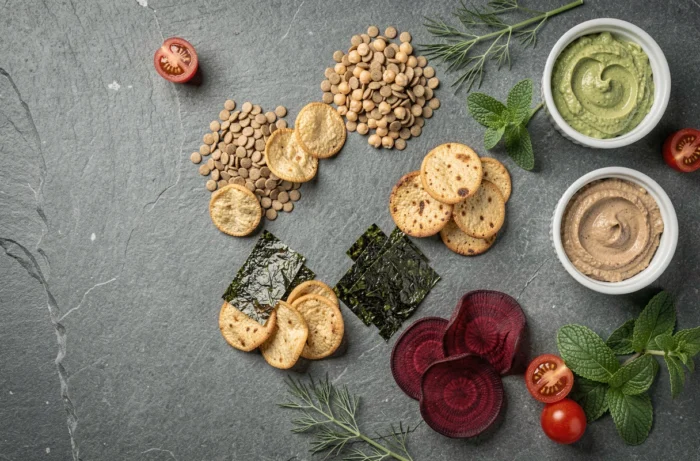
Chips made from lentils, chickpeas, or beans are gaining ground in organic aisles and supermarkets. Their real advantage: a higher protein and fiber content than classic potato chips.
However, salt remains a recurring black mark. Some references show up to 3.1 g of salt per 100 g, which is a very high level. Additives are also more frequent in this category, which can degrade the Nutri-Score despite an interesting protein profile.
Vegetable chips (beet, sweet potato, parsnip) pose another problem. Their actual composition often contains a majority of potato starch, with a low percentage of the displayed vegetable. The taste and color come more from flavors and colorings than from the vegetable itself.
Concrete criteria for reading the label in the aisle
- Salt less than 1.2 g per 100 g: beyond this, the product exceeds the threshold of a classic chip, regardless of its marketing positioning
- Short ingredient list (ideally less than five components): potatoes or legumes, oil, salt, and nothing else
- Nutri-Score B or better: references rated C remain acceptable, but a D indicates a marked imbalance on at least one criterion
- Identified type of oil: named sunflower or olive oil, rather than “vegetable oil” without specification

Homemade chips and portions: the two underestimated levers
Making homemade chips in the oven or dehydrator allows for complete control over salt, oil, and thickness of cut. Thin slices of zucchini, beet, or potato baked with a drizzle of olive oil and a pinch of salt produce a result whose composition is incomparable with an industrial product.
The other lever, rarely mentioned, concerns the portion. A reasonable portion is around 30 g, or a small handful. Most appetizers far exceed this threshold, which mechanically multiplies the intake of salt and saturated fats, even with a well-rated reference.
- Serving chips in a bowl rather than leaving the bag open reduces spontaneous consumption
- Alternating chips and raw vegetables (carrot sticks, cucumber, radishes) dilutes the overall caloric intake of the appetizer
- Favoring small packet formats curbs the reflex to finish a large bag
Shrimp chips, sometimes seen as an alternative, do not constitute a better choice. They generally contain very few shrimp and fall under an ultra-processed product comparable to classic chips in terms of salt.
Choosing a healthier chip relies on three data points that can be read in seconds: salt, the length of the ingredient list, and the Nutri-Score. No category (legumes, vegetables, baked) guarantees a favorable nutritional profile on its own. The bag that shows the fewest ingredients and a salt content below 1.2 g per 100 g remains, in most cases, the most reliable.