
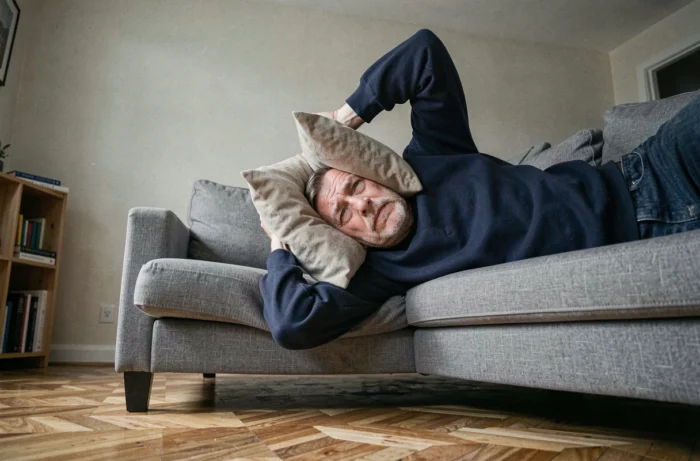
A child running in the apartment above produces impact noises that propagate through the very structure of the building. Unlike music or voices, these vibrations travel through the floor, the load-bearing walls, and reach you amplified by the resonance of your ceiling. This is not just a minor inconvenience: the repetition of these impacts at fixed times (after school, evenings, weekends) can degrade sleep and concentration in the long term.
Transmission of impact noise in buildings: what happens in your ceiling
Footsteps and running noises are solid-borne sounds. The child’s foot strikes the ground, the mechanical energy passes into the slab, then into your walls and ceiling, which in turn become vibrating surfaces. This is why sometimes the noise is heard more in a distant room than just below the source.
In buildings constructed before the 1970s, concrete slabs are often thin and lack a floating screed. The problem when dealing with a noise from a child running above is that the most effective solution (treating the neighbor’s floor) depends on their cooperation. A thick carpet in your home does not reduce impact noise coming from above, contrary to popular belief: it reduces your own footstep noise, not the noise coming through the slab.
What works on the reception side is a false ceiling decoupled on anti-vibration hangers, with a mineral wool mat in the plenum. Feedback varies on this point depending on the thickness of the original slab and the quality of the installation, but a significant reduction in impact noise is generally observed when the system is correctly installed.
2024 Law on abnormal neighborhood disturbances: what Article 1253 changes
Law No. 2024-346 of April 15, 2024, created a chapter dedicated to abnormal neighborhood disturbances in the Civil Code (Article 1253). Before this reform, abnormal neighborhood disturbance was based solely on jurisprudence. Now, the framework is codified: proof of disturbance, formal notice, mandatory attempt at amicable resolution, then litigation if necessary.
In practical terms, this structures your steps. One can no longer be satisfied with a vague letter to the property manager. It is necessary to document the disturbance (log of nuisances with dates, times, durations), send a formal notice by registered mail to the neighbor, and then go through an amicable phase (mediation or conciliation) before going to court.
Children’s noise and the threshold of abnormality
A child playing, running, and making noise in a dwelling is considered normal behavior in communal living. Jurisprudence regularly confirms this: the cries of a baby or the common noises of a young child do not constitute an abnormal disturbance, even at night.
However, the Angers Court of Appeal (February 28, 2023) ordered the eviction of tenants whose children generated repeated running and screaming noises despite two warnings from the landlord. The nuance is there: it is not the noise itself, but its repeated, intensive nature and the lack of response from the parents that shifts the situation towards abnormal disturbance.
Acoustic insulation of the ceiling: technical solutions from below
When dialogue with the neighbor yields no results (we’ll get to that), there remains the technical route on the reception side. Here are realistic options ranked by decreasing effectiveness.
- False ceiling on anti-vibration hangers with mineral wool: the most effective solution. It requires losing between 10 and 15 cm of ceiling height, making it impractical in some older apartments with low ceilings.
- Acoustic panels glued directly under the slab: modest gain on airborne noises (voices, music), but very little attenuation of impact noises because the panel remains bonded to the vibrating structure.
- Floating screed on the neighbor’s side above: the most effective of all, but it requires the agreement and financial participation of the neighbor. It involves decoupling the floor covering from the slab with a resilient underlayment.
A often overlooked point: lateral transmissions. Even with an excellent false ceiling, noise can pass through the adjoining walls if they are in direct contact with the neighbor’s slab. An acoustician can identify these sound bridges before engaging in costly work.
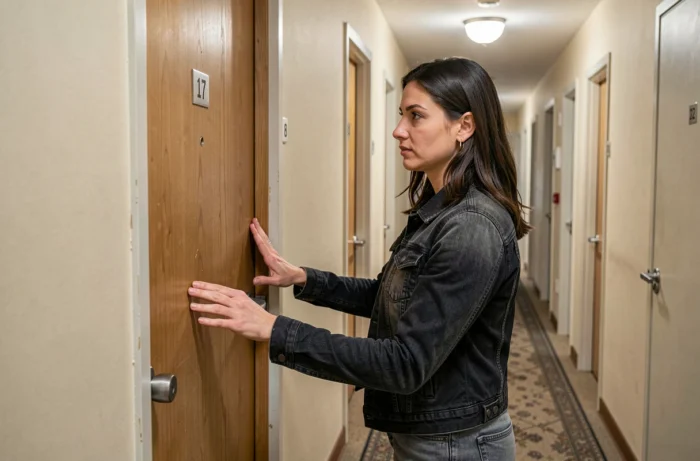
Negotiating with the neighbor above: a ground approach
It is observed that most neighbors with children are unaware of the noise level perceived below. Going up to ring the doorbell during a running episode is often more effective than a letter: the neighbor then hears the calm returned in their home and misunderstands the problem. Proposing to invite them over while their children play changes the perception.
If the dialogue works, the simplest option for the neighbor is to install a soft floor covering in the play areas (thick foam tiles, high-density carpets). This is not a technical insulation solution, but it reduces the energy of each impact at the source, which is always more effective than treating from below.
When dialogue fails
In case of refusal or lack of change, the process outlined by the 2024 law applies:
- Compile a file: dated and detailed log of nuisances, written testimonies from neighbors, possibly a bailiff’s report.
- Send a formal notice by registered mail with acknowledgment of receipt, citing Article 1253 of the Civil Code.
- Engage a conciliator (free) or a mediator before any legal action.
- As a last resort, file a lawsuit in court for abnormal neighborhood disturbance.
The landlord of the neighbor (if they are a tenant) has an obligation to act: the peaceful enjoyment clause of the lease compels them to intervene with their tenant. Writing to the landlord alongside the letter to the neighbor often speeds things up.
Managing the noise of a child running above rarely goes through a single solution. The combination of a decoupled false ceiling in your home and a soft covering in the neighbor’s apartment yields the best results. The legal framework resulting from the 2024 law provides an additional lever, but the file must be solid: dates, times, testimonies. Without precise documentation, no procedure will succeed.