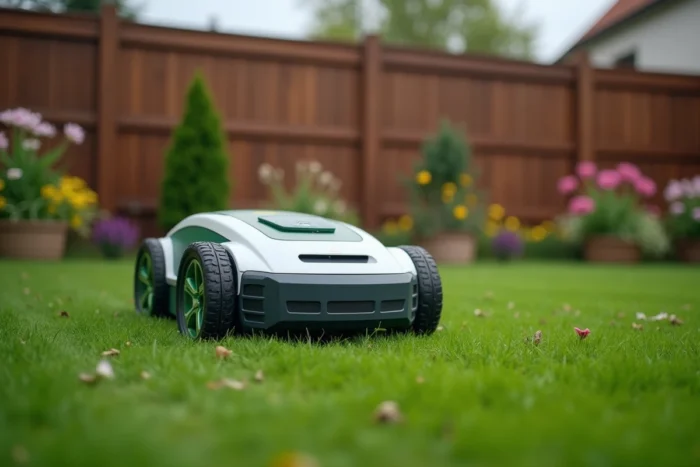
Mowing your lawn effortlessly for under 200 euros is the promise Lidl renews every spring with its Parkside robotic mowers. The City PAMRC 250 A1 model was notably priced at 149 euros during the July 2026 sales, a price that cleared the shelves in just a few days. At this price point, the question deserves to be asked: does this robot really deliver on its promises in the field?
Perimeter cable and random navigation: what this means in daily life
Before discussing mowing results, it’s essential to understand how the Parkside navigates your garden. The principle is simple: you lay a cable on the ground (or bury it slightly) all around the area to be mowed. This wire emits a signal that prevents the robot from leaving the defined perimeter.
Once in this area, the robot moves randomly. It advances in a straight line, encounters an obstacle or the cable, changes direction, and starts again. No mapping, no camera, no optimized path.
Some areas are mowed multiple times before others are covered. In a small rectangular garden, this is not a problem: the robot eventually passes everywhere. In an L-shaped yard, with flower beds or narrow passages, the gaps become noticeable. The corners often remain less well treated, and sometimes you need to go back manually over the edges.
If you’ve ever considered the Parkside robotic mower at Lidl, keep in mind that installing the cable takes one to two hours depending on the complexity of the terrain, including fixing stakes.
Mowing quality of the Parkside PAMRS 1000 A1: results on the lawn
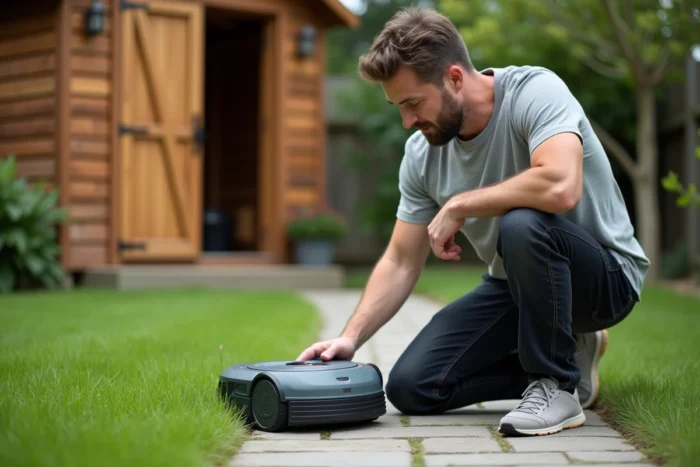
The Parkside uses a system of rotating blades mounted on a disc. Three small pivoting blades cut the grass blades by impact, like most robotic mowers on the market. The cutting height is adjusted manually, and the robot operates by frequent passes to maintain a short lawn.
In its test, Les Numériques noted a quiet operation but pointed out a blind navigation that leaves uneven traces. The result is acceptable on a flat and clear lawn, provided the robot is allowed to run daily.
Have you ever noticed those lighter stripes that some neighbors have on their lawn? They often come from a robot that does not cover the surface evenly. With the Parkside, this phenomenon appears mainly in the first few weeks, before repeated passes smooth out the result.
What the blades change over time
The blades of a robotic mower wear out faster than you might think. On the Parkside, they are replaceable at a modest cost. Changing the blades every six to eight weeks keeps a clean cut. Dull blades tear the grass instead of cutting it, which yellows the lawn.
Repairability index and spare parts: an underrated strength
Why does this criterion deserve your attention? Because a low-cost robotic mower becomes a poor purchase if it ends up in the trash after two seasons. The Parkside PAMRC 250 A1 City boasts a repairability index of 8.6 out of 10, a score rarely highlighted in comparisons.
This figure, reported by La Voix du Nord, means that spare parts are easily accessible and that the design facilitates disassembly. Battery, blades, wheels, electronic board: the components most exposed to wear can be replaced without going through a specialized repairer.
For a product sold for around 150 to 240 euros depending on promotions, this is a strong argument. Many competing robots in this price range do not even disclose their repairability index.
- Replaceable rotating blades in just a few minutes without specific tools
- 20 V battery compatible with other devices in the Parkside range
- Disassembly documentation available, making simple repairs easier
Bluetooth and mobile app: what the Parkside app really controls
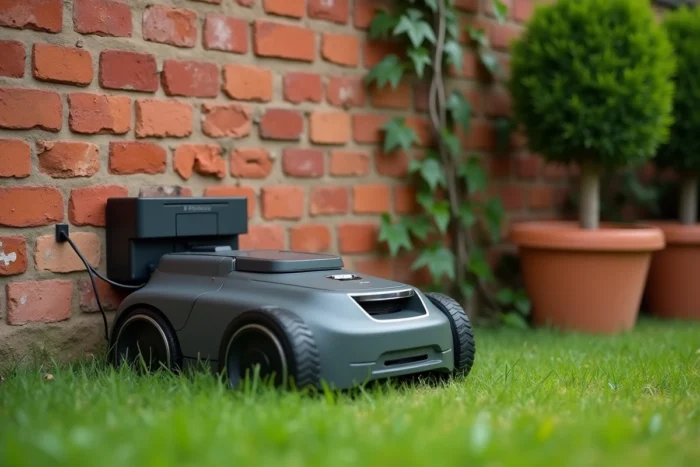
The Parkside PAMRS 1000 A1 connects via Bluetooth to a mobile app. No Wi-Fi, no remote control from the office. The Bluetooth connection works only in proximity to the robot, within a few meters.
The app allows you to schedule mowing times, adjust the cutting height, and check the battery status. The interface remains basic compared to those offered by Husqvarna or Gardena, but it covers daily adjustments.
What to remember: the app does not turn the Parkside into a remotely controllable connected device. It simply replaces physical buttons with a touchscreen, as long as you stay close to the machine.
What type of garden is a Parkside robotic mower really suitable for?
The very low price of the Parkside attracts a variety of profiles, but this robot is not suitable for all gardens. Here are the cases where it performs well:
- Flat terrain or very gentle slopes, without marked elevation
- Simple surface (rectangle, square) without too many flower beds or ground obstacles
- Small garden, typically up to 250 m² for the City model
- Owner willing to let the robot run daily to compensate for random navigation
On the other hand, a terrain with narrow passages, slopes beyond 25%, or many trees will expose the system’s limits. Robots with camera or GPS navigation, offered by Parkside in its Performance range (PPAMR 1250 A1) or by other brands, handle these configurations better.
A robot priced at 149 euros does not replace a model priced at 800 euros, and that is not what is expected of it. In a small urban garden without relief, the Parkside City ensures regular mowing as long as it is allowed to run every day. For a complex or larger terrain, it is better to upgrade, even if it means waiting for a promotion on a better-equipped model.