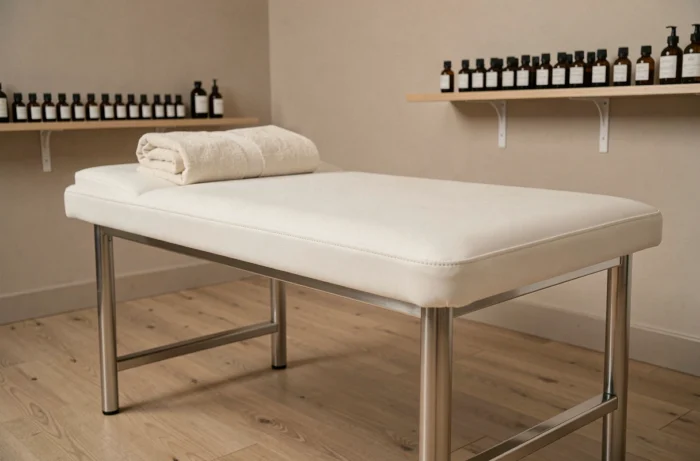
A massage table is defined by its working surface, its adjustment mechanism, and the materials that make up its covering and structure. These three parameters evolve under the influence of new constraints: more technical care protocols, enhanced hygiene requirements, and the gradual integration of technologies in high-end wellness spaces.
Connected massage tables: sensors and immersive environments
The least covered segment by usual comparisons concerns tables that integrate advanced technologies. In 2026, several manufacturers positioned in the luxury spa market offer models equipped with muscle tension sensors capable of transmitting real-time data to the practitioner.
The goal is not to replace manual techniques but to provide a mapping of contraction areas before and during the treatment. The practitioner thus adapts their pressure and technique based on objective feedback, not solely on tactile sensation.
Some models go further by integrating pulsed electromagnetic field (PEMF) therapy modules. This technology, originating from the medical field, is now adapted for wellness in tables designed for biohacking centers and high-end spas. The manufacturer Gharieni, for example, markets tables combining heated quartz surfaces and sensory stimulation modules, designed for immersive body-mind protocols.
The news from the La Table De Massage site allows tracking the arrival of these models on the French market, where demand is currently concentrated on premium establishments.
Ergonomics and QVT regulations: what changes for practitioners
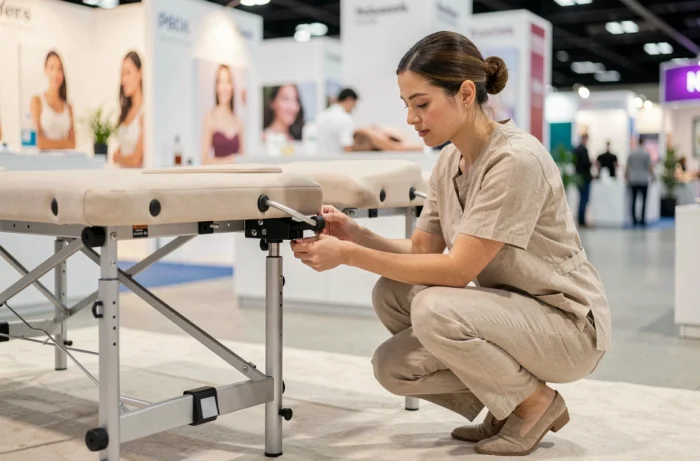
The ergonomics of a massage table has long been considered from the client’s perspective. The trend that has emerged in recent years reverses this logic: the health of the practitioner becomes a central design criterion.
Musculoskeletal disorders represent a documented occupational risk for masseurs and physiotherapists. Working height, the ability to vary positions without effort, and the smoothness of electric adjustments directly influence longevity in the profession.
Motorization and number of motors
The choice between two or three motors determines the degree of independence of the sections of the table. A two-motor model allows for the adjustment of height and backrest inclination. With three motors or more, each section (head, torso, legs) can be positioned independently.
- Two motors are sufficient for classic massage and modeling protocols, where the lying position predominates.
- Three motors become relevant as soon as the practitioner alternates between facial treatments, lymphatic drainage, and body techniques in the same cabin.
- Beyond three motors, we enter the segment of medical tables or high-end spa equipment, with prices that increase significantly.
Transitioning from one treatment to another without manual manipulation of the table reduces transition times and preserves the fluidity of the client experience. A silent and continuous adjustment avoids breaking the atmosphere of the treatment, a detail that weighs heavily in the client’s perception of quality.
Coverings and hygiene: new requirements for treatment furniture
The covering of a massage table serves three functions: tactile comfort, mechanical resistance, and ease of disinfection. Post-pandemic hygiene standards have accelerated the adoption of technical materials in this area.
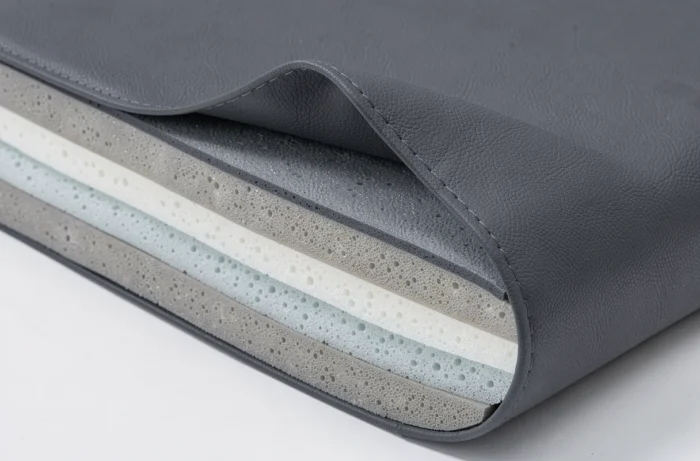
Seamless polyurethane coverings limit areas of bacterial accumulation. Some manufacturers now integrate antimicrobial treatments directly into the material of the covering, rather than as a superficial layer that wears away over time.
The density of the foam under the covering also plays a role that is often underestimated. Foam that is too soft deforms quickly and creates dips that complicate cleaning. High-resilience foam retains its shape for several years and maintains a flat surface, making it easier to disinfect between clients.
Integrated LED lighting, a recent addition
Several models marketed in 2026 include LED lighting under the base of the table. This option, offered notably by French manufacturers like MFB Provence, is not just a gimmick. Ambient lighting contributes to chromotherapy and allows the practitioner to work in dim light without installing additional equipment in the cabin.
Versatility of a massage table in a single cabin
For a practitioner working alone or in a limited space, the table must serve multiple types of treatments. The versatility of a model is measured by three concrete elements: height range, modularity of sections, and compatibility with accessories (removable headrest, armrests, arm supports).
A table that can lower sufficiently allows for seated treatments (reflexology, cranial massage) without a specific stool. Conversely, a high maximum height facilitates standing procedures such as facial treatments or instrumental aesthetic techniques.
The market is moving towards models that replace multiple pieces of furniture: the same table serves for body modeling, a facial treatment with an elevated backrest, and drainage with the Trendelenburg position (elevated legs). This convergence reduces investment in furniture and optimizes space in the cabin.
Manufacturers that stand out are those offering accessories compatible across ranges, allowing the practitioner to evolve their table without replacing it. A higher initial investment in a modular table is offset by the absence of repurchase with each protocol change.