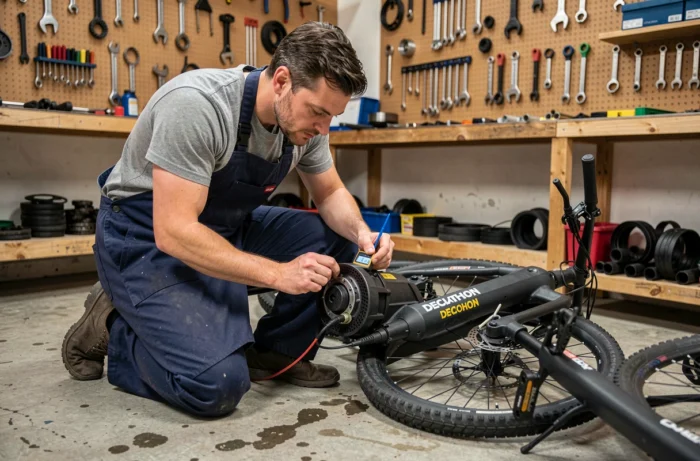
A Decathlon electric bike that refuses to start or whose assistance cuts out mid-climb rarely has a motor problem. In most cases, the failure comes from a peripheral element: connectors, sensors, or electronic battery management. Understanding these mechanisms can prevent a trip to the workshop for a simple oxidized terminal.
Loose connections and wiring on a Decathlon e-bike
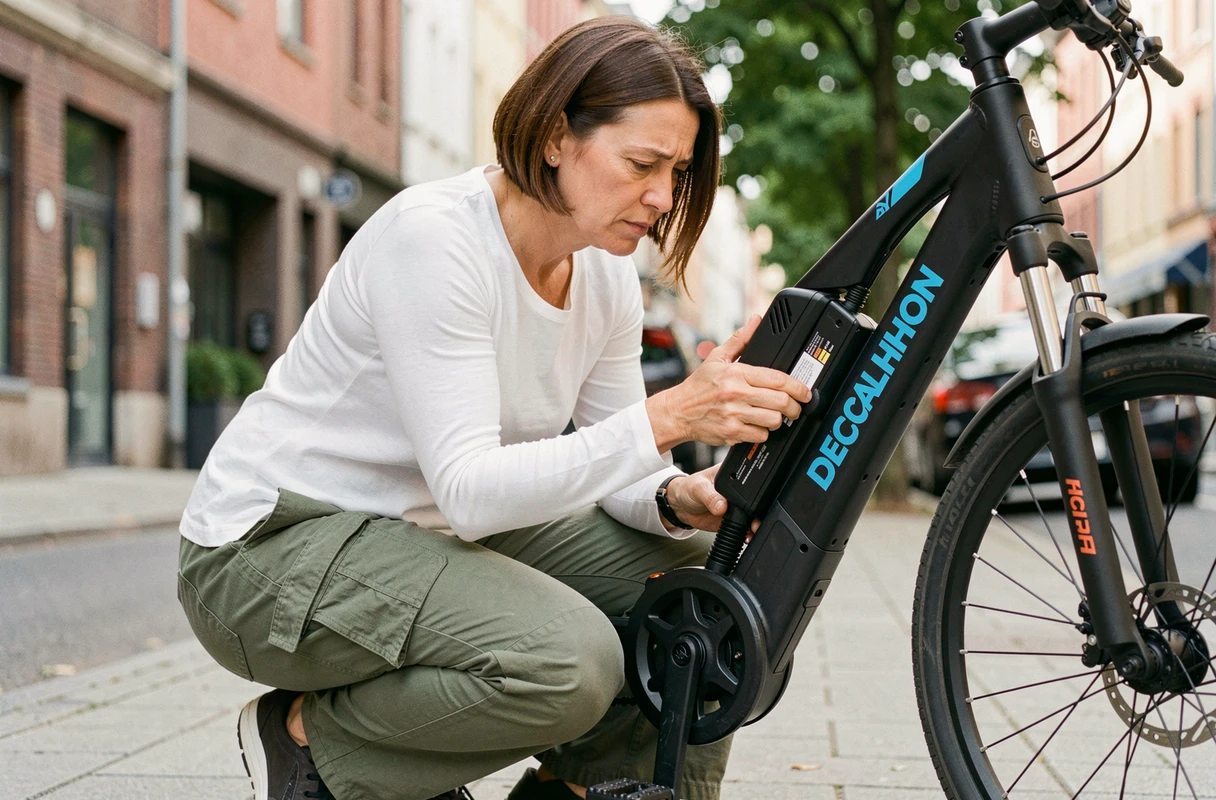
Before suspecting a faulty battery or a motor at the end of its life, the first instinct is to check the wiring. On B’Twin, Rockrider, or Riverside models, a battery not properly seated in its housing is enough to cut all assistance.
The problem often manifests after hitting a pothole or a curb: the battery becomes loose, the electrical contact becomes intermittent, and the assistance cuts out and then returns randomly. This symptom is characteristic of a mechanical fixation issue, not an electronic failure.
The contact terminals between the battery and the frame oxidize over time, especially after rides in the rain or a pressure wash. Cleaning the contacts with a dry cloth and a bit of isopropyl alcohol restores the connection in most situations. Also, check that the charger connector is not loose or deformed.
User feedback compiled on the Decathlon electric bike failure forum confirms that this check resolves a significant portion of reported failures, before any further diagnosis.
Pedal sensor: the invisible failure of electric bikes
The pedal sensor is the component that informs the controller that the pedals are turning. Without this signal, the motor receives no instructions, and the assistance remains inactive, even if the battery is full and the screen is on.
On Decathlon e-bikes, this sensor works with a magnetized disc attached to the crankshaft. Each time a magnet passes in front of the sensor, it generates a pulse. Two types of malfunctions frequently occur:
- The magnetized disc shifts after a shock or rear wheel removal, and the magnets no longer pass in front of the sensor. The gap between the magnets and the sensor must remain very small for the signal to be detected.
- The sensor itself can become dirty with dust, mud, or chain grease. A gentle cleaning with a cloth is usually enough to restore detection.
- The sensor cable may be pinched between the frame and the crankset, causing intermittent assistance cuts, especially when the bike vibrates on rough roads.
A dirty or misaligned sensor reproduces exactly the symptoms of a faulty motor. Checking its condition before concluding a motor failure avoids an erroneous diagnosis and an unnecessary bill.
BMS and incomplete battery charging
A battery for an electric bike that no longer charges to its maximum capacity is not necessarily a battery that needs replacing. The BMS (Battery Management System) is a circuit integrated into each lithium-ion cell pack. Its role is to monitor the voltage of each cell group and cut off charging if one of them reaches a critical threshold.
When a cell ages faster than the others, the BMS blocks the overall charge to protect the entire pack. The visible result: the battery shows a level lower than its full capacity, without the other cells being worn out.
Inappropriate charger or oxidized contacts
A charger whose output voltage does not exactly match the battery specifications can also trigger a BMS protection. On Decathlon models, using a third-party charger not validated by the manufacturer sometimes causes this blockage. Oxidized contacts between the charger and the charging socket produce the same effect: the BMS detects an unstable voltage and interrupts the charge for safety.
Before concluding that the battery is at the end of its life, it is necessary to clean the charging contacts, check that the original charger is functioning correctly, and, if possible, test with another compatible charger.
Assistance cuts after rain or bike washing
Intermittent cuts that appear after a downpour or cleaning are a special case. Water does not cause a direct short circuit on a well-designed e-bike, but it seeps into the connectors and creates micro-bridges of moisture that disrupt signals.
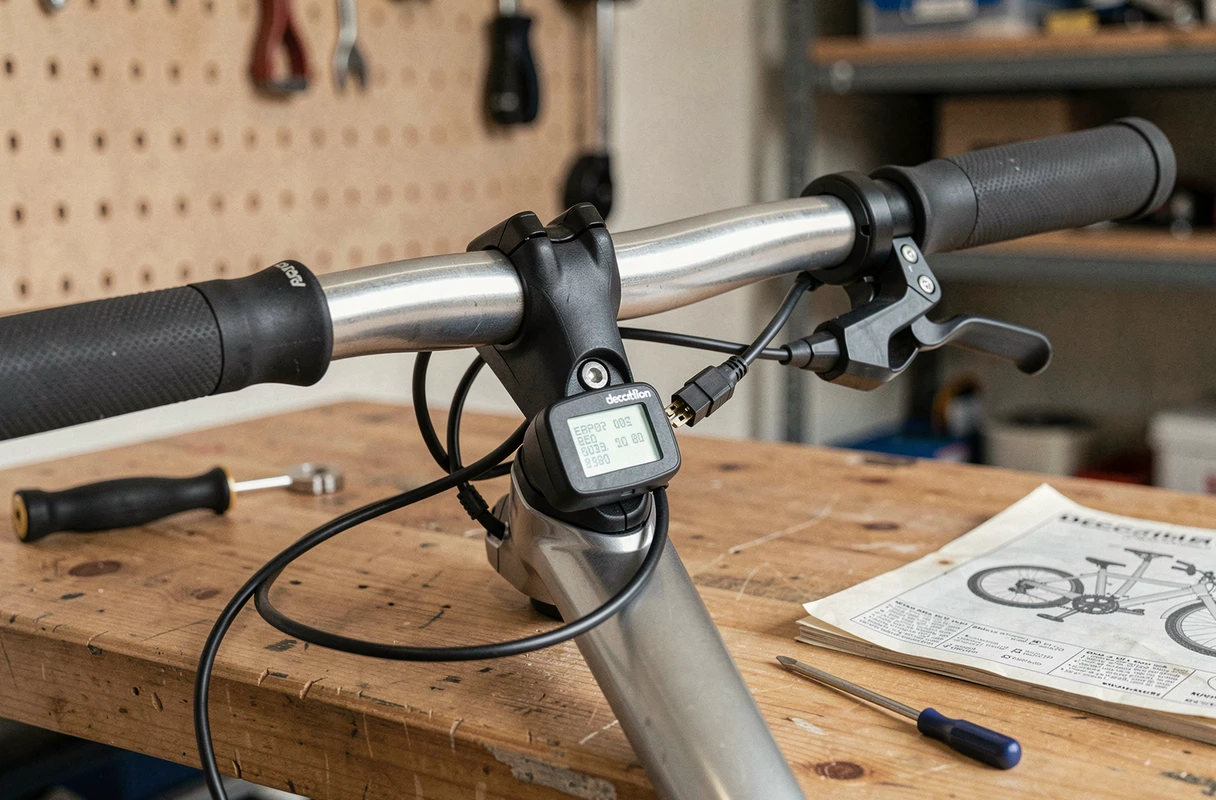
On Decathlon electric bikes, the connectors located at the rear hub motor and those of the display are the most exposed. After a wet episode, drying the connectors and leaving them in the open air for a few hours resolves the majority of these cuts.
High-pressure washing is still not recommended. The pressure forces water into seals designed to withstand rain, not a cleaner. A bucket of soapy water and a sponge protect the wiring without risk.
Error codes on the e-bike screen
Some models display an error code on the display after water infiltration. These codes correspond to a communication interruption between the controller and the motor or sensor. A system reset (turning off the screen, removing the battery for a few minutes, then reconnecting everything) is often enough to clear the error. If the code persists after complete drying, a workshop diagnosis becomes relevant.
Most failures on a Decathlon electric bike focus on three points: the battery wiring, the pedal sensor, and the electronic charge management. Checking these elements in this order covers the majority of cases and requires no specialized tools. The motor itself rarely fails on these models.