
A restaurant manager in Lyon who wants to transition from a micro-entrepreneur to an LLC to partner with his chef, a graphic designer in Nantes who is hesitating between a sole proprietorship and a simplified joint-stock company to protect her personal assets: starting a business in France involves concrete choices, often irreversible for several years. The legal status, tax regime, and daily management form a set where each decision conditions the next.
Mandatory electronic invoicing: what changes from September 2026 for all new businesses
Before even discussing statuses, a technical subject arises for anyone starting a business in 2026. Electronic invoicing becomes mandatory from September 1, 2026 for all French businesses, regardless of their size. We are not talking about simply sending a PDF by email: it involves issuing and receiving invoices in a structured format, via a partner dematerialization platform.
In practical terms, this means that the choice of management software must be made before registration, not after. A self-employed person starting in October 2026 without a compatible tool will be in violation from their first invoice. To anticipate this point and other formalities related to creation, centralized resources can be found at https://info-entreprises.fr/ that group procedures by type of activity.
Feedback varies on the actual complexity of implementation, but the principle remains the same: integrate this constraint into the startup budget, including for the lightest structures.
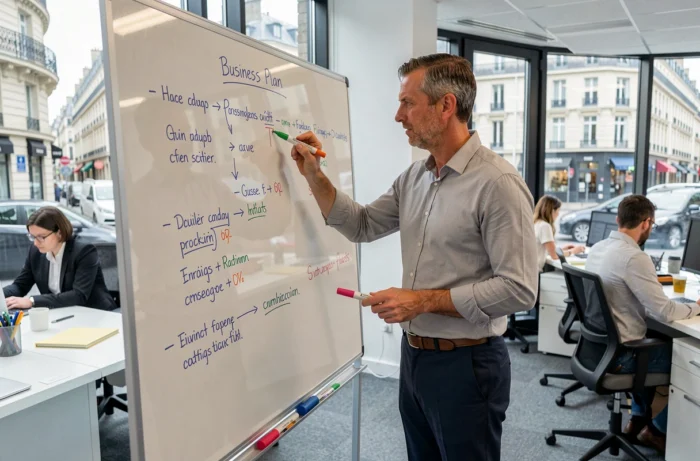
Business legal status: deciding between personal protection and tax flexibility
The choice of legal status is not a theoretical exercise. It determines three concrete things: the financial responsibility of the manager, the social regime to which they are affiliated, and the available tax options.
Micro-enterprise or company: two incompatible logics
The micro-enterprise is suitable when testing an activity alone, with few expenses and no need to partner. The micro regime simplifies accounting but caps revenue and does not allow for the deduction of actual expenses.
As soon as one anticipates investments (equipment, premises, stock) or wants to limit their liability to the capital contributed, the company becomes necessary. EURL to remain solo with protective framework, LLC to partner, SASU to benefit from the general regime as president: each form has its operational constraints.
EURL versus SASU: the real criterion for choice
It is often said that SASU is “more modern.” In practice, the difference lies in the social cost of the manager’s remuneration. The manager of an EURL falls under the independent worker regime, with generally lower contributions. The president of a SASU is considered an employee, with better social coverage but a heavier cost for the company.
The choice depends on the expected level of remuneration and the profit distribution strategy (salary, dividends, or a mix of both). Not on the perceived prestige of the legal form.
Registration at the single window: common blockages and how to avoid them
Since the centralization of formalities at the INPI’s single window, all business creations go through this platform. The process is dematerialized, but it generates recurring errors that delay registration by several weeks.
- The incorrectly filled APE code: if the declared activity does not precisely match the INSEE nomenclature, the file is rejected. Check the exact code before filling out the form, not after the refusal.
- Incomplete statutes for companies: a vague business purpose, lack of a management clause, or an error on the capital amount lead to systematic rejection. Having the statutes reviewed by a legal professional costs a few hundred euros but avoids a month of delay.
- The missing domiciliation certificate: every business must justify a registered office address upon submission of the file. A lease, a commercial domiciliation contract, or a certificate of provision from a host are accepted.
- For certain liberal activities and micro-enterprises, URSSAF now intervenes in the validation of formalities submitted via the single window, adding an additional processing step.

ACRE in 2026: tightened access conditions to know before launching
The Aid for Business Creators and Buyers remains a financial lever to reduce initial social contributions. Since January 1, 2026, eligibility conditions have been tightened. The exemption now only targets limitatively enumerated categories, whereas it was previously more broadly accessible.
For micro-entrepreneurs, the technical application of this reform is scheduled to start from July 1, 2026. In practice, this means that a creator who submits their file thinking they will automatically benefit from ACRE may find themselves without exemption if they do not fall into the new categories. The request must be submitted as soon as the activity is created, as it is not retroactive.
Daily business management: the three areas that consume the most time
Once the business is registered, operational management takes over. Three areas consistently emerge as the most time-consuming for small business leaders.
Cash flow first. Tracking receipts, following up on unpaid invoices, anticipating gaps between fixed costs and revenue. A weekly tracking spreadsheet (even on a spreadsheet) is better than sophisticated software that is never opened.
Next, the reporting obligations. Monthly or quarterly VAT, social declarations, annual tax return for companies. The tax calendar dictates the administrative organization of the business, not the other way around.
Finally, client relations. Quotes, contracts, general terms of sale: these documents protect as much as they sell. Neglecting them at the start creates disputes that cost much more than an hour spent drafting them correctly.
Starting a business in France in 2026 requires integrating from the outset constraints that did not exist two years ago, particularly electronic invoicing and the tightening of ACRE. The legal status remains the first structuring decision, but it is the management rigor in the early months that determines whether the activity lasts over time.