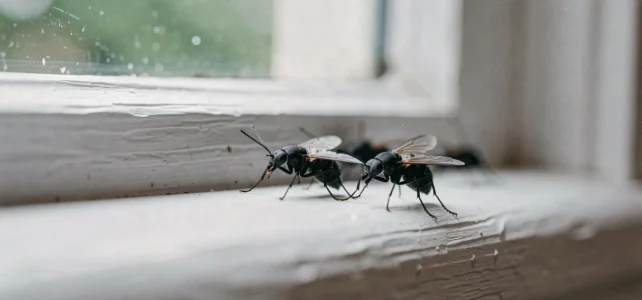
Small black insects accumulating on the ledge of your windows do not necessarily mean that these insects entered through the open window. In most cases, their presence in that specific spot indicates an attraction to natural light, while they have entered through another point of the building’s envelope. Understanding this distinction radically changes the way to react.
Building airtightness defects: the real entry point for black insects
Popular guides repeat the same advice: close your windows or install screens. This reflex only addresses part of the problem. Feedback from architects specializing in airtightness of housing documents a different observation: the majority of intrusions occur through defects in the building, not through conventional openings.
Poorly insulated roller shutter boxes, aging window seals, electrical or plumbing penetrations, and door thresholds lacking brushes are all discreet entry points. Insects enter through these flaws, move within the walls or attics, and then converge towards the nearest light source, which is the window.
Observing small black insects near windows often means noting the point of arrival, not the point of entry. Before addressing the insect itself, an inspection of the shutter boxes, peripheral seals, and low vents allows for locating the actual flaw.
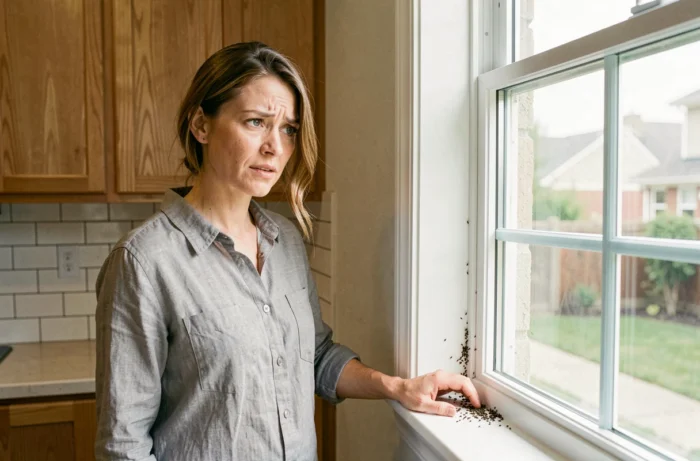
Identifying the black insect by its size and behavior
Not all small black insects present the same problem. Size and behavior reveal more quickly than a magnifying glass. Two criteria are enough to guide the diagnosis before searching for a species name.
Insects under 3 mm
At this size, the most common suspects indoors are carpet beetles, psocids (book lice), and certain mold beetles. Carpet beetles, often confused with moving black dots, feed on textile fibers, animal hair, and dead skin. Psocids, on the other hand, indicate excess moisture as they develop on microscopic molds.
If the insect does not fly and stays near curtains or baseboards, the carpet beetle is the most likely candidate. If it appears more in the bathroom or a poorly ventilated room, the book louse should be considered.
Insects from 3 to 6 mm
In this range, woodboring beetles and field bugs dominate. Adult woodboring beetles measure a few millimeters, fly poorly, and are often found on the ground or window sills after leaving the wood in which they developed. Their presence is accompanied by small round holes in furniture, beams, or woodwork, and fine sawdust at the base of affected elements.
Field bugs (notably the elm bug) can invade facades and windows by the hundreds on certain hot days. This phenomenon is seasonal and harmless: they do not bite, do not reproduce indoors, and disappear within a few days.
Insects over 6 mm
A black insect of this size on a window sill is often a ground beetle (a garden predator that entered by chance), a earwig, or, in the worst case, an oriental cockroach. The ground beetle is recognizable by its long legs and rapid movement. The earwig has cerci (pincers) at the back of its abdomen. The oriental cockroach is distinguished by its flattened, shiny body, nocturnal activity, and tendency to flee from light.
Woodboring beetles and xylophagous insects: when presence indicates structural damage
Among the scenarios not to be overlooked, that of xylophagous insects deserves special attention. Woodboring beetles (small and large) lay eggs in wood. The larvae burrow galleries for several years before the adult emerges through a hole a few millimeters wide.
Finding dead woodboring beetles on the floor or windows indicates that the cycle has completed and that adults have recently emerged. Three signs to check:
- Round holes (1 to 4 mm in diameter) on beams, antique furniture, or woodwork, with fresh sawdust underneath
- Wood that sounds hollow when tapped, a sign of extensive internal galleries
- The repeated presence of small black or brown beetles every spring-summer, proof that the infestation is active and not residual
When holes multiply on load-bearing elements (beams, joists, framework), a diagnosis by a wood treatment professional is necessary. An active woodboring beetle infestation for several years can compromise the strength of a beam.
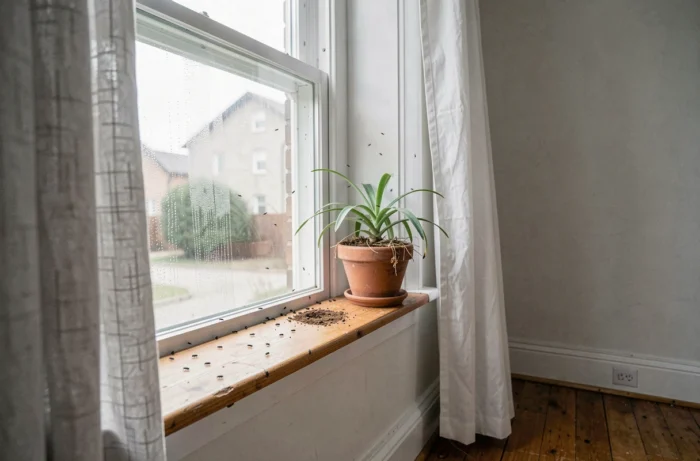
Indoor humidity and mold: the underestimated triggering factor
Several species of small black insects in the house directly depend on humidity levels. Psocids feed exclusively on mold. Mold beetles (Lathridiidae), tiny and often confused with black dots, follow the same logic. Carpet beetles, although less linked to humidity, proliferate more in homes where organic dust accumulates.
A home where these insects appear recurrently near windows, in the bathroom, or behind curtains often presents one of these problems:
- Insufficient ventilation (no mechanical ventilation, obstructed vents, bathroom without extraction)
- A thermal bridge around windows causing condensation on joinery or adjacent walls
- A slow water leak (under a sink, in a partition) feeding an invisible mold source
Treating the insect without correcting the humidity is like mopping the floor without turning off the tap. A dehumidifier or occasional cleaning does not replace resolving the ventilation or airtightness defect.
Health risks for humans and pets
Most small black insects found near windows are harmless to humans. Carpet beetles, psocids, and woodboring beetles do not bite and do not transmit diseases. The hairs of carpet beetle larvae can cause skin irritation in sensitive individuals, sometimes confused with bites.
Pets do not face direct risks from these species. Pet food stored in open containers may attract certain food beetles, but the risk remains limited to contamination of the food itself.
The real health alert concerns the molds that these insects reveal. A home that hosts psocids presents a humidity level favorable to mold spores, which affect indoor air quality much more than the insects themselves.
Before purchasing an insecticide, the most useful action remains to check three points: the condition of your window seals, the proper functioning of your ventilation, and the absence of micro-leaks. These three checks resolve the majority of cases without any chemical products.