
A desk that’s too narrow to hold a screen and documents, a chair that causes lower back pain after two hours, an improvised office corner on the dining table: we all know these situations. Choosing office equipment is not just about finding a piece of furniture that fits in the room. It’s primarily a matter of physical constraints, actual use, and material durability.
Tabletop surface and depth: the dimensions that change everything
Before looking at design or color, we measure. The depth of the tabletop determines the distance between the eyes and the screen, and this distance directly influences the posture of the upper back and neck.
For a workstation with a screen, a minimum depth of 60 cm is a practical threshold below which one tends to lean forward. If a second screen or paper documents are added, aiming for 70 to 80 cm avoids sacrificing useful workspace.
The width of the tabletop depends on the number of tools permanently placed on it. A straight desk of 120 cm is suitable for a laptop and some supplies. As soon as one works with a fixed screen, an external keyboard, and a printer within reach, a tabletop of 140 to 160 cm becomes necessary.
One can also consider a corner desk to utilize a corner of the room without losing floor space, a choice particularly suited for remote work in a bedroom or a repurposed living room.
To find configurations suitable for these dimensional constraints, one can consult the office equipment at Concept Habitat which covers various tabletop formats and layouts.
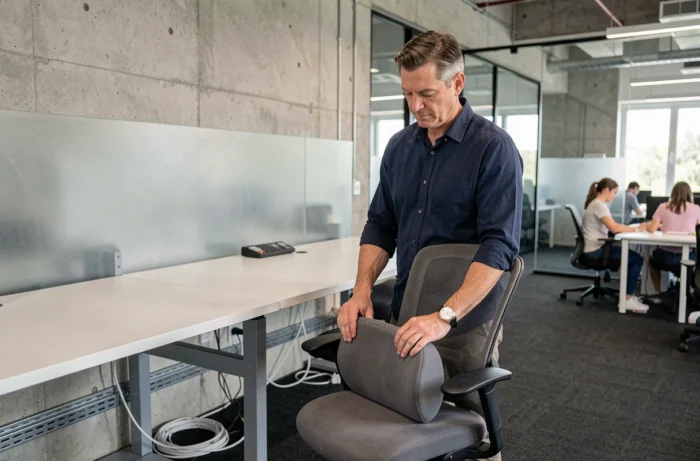
Desk height and seat adjustment: the ergonomic duo
A desk without the right chair (or vice versa) is useless. These two elements work in tandem, and their combined adjustment determines the working posture.
Fixed height or adjustable tabletop
Most standard desks are around 72 to 75 cm in height. This suits a person measuring between 1.70 m and 1.80 m sitting on an adjustable seat. Outside of this range, a height-adjustable desk remains the most versatile solution, especially in a household where multiple people share the same workstation.
Sit-stand models, equipped with electric lifts, also allow for varying postures throughout the day. The European market for standing desks is experiencing strong growth, indicating that this practice is becoming a common usage rather than just a trend.
The seat: three adjustments to check above all
One can spend a lot on an office chair without achieving comfort, simply because the adjustments do not match their body type. Three points deserve systematic checking:
- The seat height should allow the feet to rest flat on the ground, thighs horizontal, without pressure under the knees
- The lumbar support should fit into the curve of the lower back, not in the middle of the shoulder blades. A height- and depth-adjustable support adapts to more body types
- The armrests, often overlooked, should be adjustable so that the forearms rest at the height of the tabletop, elbows at about 90 degrees. Armrests that are too high or too low shift tension to the shoulders
A poorly adjusted seat negates the benefits of a well-sized desk. It is recommended to spend five minutes adjusting each parameter during the initial setup.
Office furniture materials: solid wood, melamine, or metal
The choice of material has implications for lifespan, weight, budget, and daily maintenance. Three main categories are distinguished.
Solid wood (oak, beech, pine) offers superior robustness and longevity. A solid wood tabletop can support heavy loads and ages well, but its weight complicates frequent rearrangements and its price is higher.
Melamine board, the most common, combines a particleboard core with a decorative coating. Melamine remains the best compromise between cost and durability for everyday use. Its surface is easy to clean and resists light scratches. Feedback varies on the longevity of the edges (the borders of the tabletop), which may peel after a few years on entry-level models.
Metal structures (steel legs, tubular frames) provide stability, especially on larger formats and height-adjustable desks. They are generally combined with a wood or melamine tabletop.
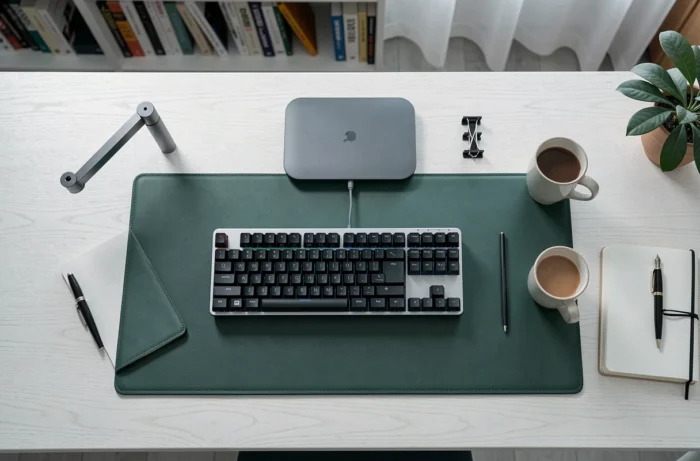
Setting up a home office workstation: specific constraints
Working from home imposes compromises that are not encountered in a dedicated office. The available space is often limited, shared with other uses, and the acoustics are rarely designed for concentration.
The French standard NF X 35-102 recommends about 10 m² per person in a professional office. At home, one rarely has this surface. A compact desk with integrated storage (drawers under the tabletop, side shelf) allows for gathering all essentials without cluttering the room.
Side natural lighting reduces visual fatigue much better than a desk lamp alone. Positioning the tabletop perpendicular to the window avoids reflections on the screen while benefiting from daylight.
On the acoustic side, a simple felt panel fixed to the wall behind the screen reduces reverberation during video conferences, without heavy work.
Second-hand office furniture: an option to consider
The French office furniture market declined in value in 2024, but the segment of second-hand furniture is experiencing marked growth. Companies renewing their inventory sell ergonomic chairs, height-adjustable desks, and storage units in good condition, often at a fraction of the new price.
A refurbished professional desk or chair has generally been designed for intensive use. Its durability exceeds that of most new consumer furniture sold at the same price. Before purchasing, one should check the condition of the adjustment mechanisms, the wear of the seat covering, and the flatness of the tabletop.
The ongoing revision of the European directive on display screen workstations, aimed at better regulating remote work and hybrid configurations, could also evolve the criteria for choosing equipment in the coming years. Anticipating these changes by choosing modular furniture remains a reasonable strategy, whether equipping a professional office or a home workspace.