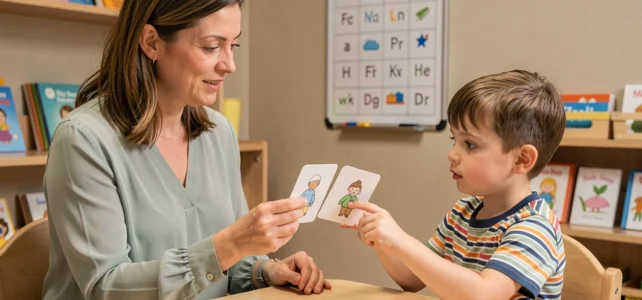
Logopedics and speech therapy refer to the same discipline in French-speaking regions: the study and management of communication disorders, oral language, written language, and voice. In Belgium and Switzerland, the term logopedics is used, while France uses the term speech therapy. The work is based on an identical principle: to evaluate a patient’s linguistic mechanisms, identify what is dysfunctional, and then propose targeted strategies to restore or develop communication.
Difference between logopedics and speech therapy: two terms for the same discipline
The confusion between logopedics and speech therapy persists because the training and fields of intervention almost completely overlap. A logopedist trained in Brussels and a speech therapist graduated in Lyon treat the same pathologies: language delay in children, articulation disorders, stuttering, dyslexia, aphasia after a stroke.
The difference lies in the administrative terminology and the university curriculum. In France, the diploma is obtained after five years of studies in language and communication sciences. In Belgium, the logopedics training follows a comparable duration, with sometimes a stronger emphasis on neuropsychology depending on the universities.
For families seeking support, the distinction has no practical impact on the quality of care. What matters is the initial speech therapy assessment, which allows for a precise diagnosis and defines the rehabilitation goals. Specialized structures like centre-logos.fr bring together professionals trained in these different approaches to support children and adults.
Language disorders in children: spotting signals before the assessment
Waiting for an appointment with the speech therapist can take several months. This waiting period is not idle time: it can be used to observe the child’s language behavior and adjust family communication.
What deserves attention according to age
A child who, at two years old, does not use any isolated words or who, at three years old, does not combine two words to form a rudimentary sentence presents a language delay that justifies a consultation. Before school, the absence of pointing, lack of reaction to their name, or very limited eye contact are also serious indicators.
While waiting for the assessment, collaboration with the teacher is an underutilized lever. Reporting difficulties observed at home allows the school to implement simple adaptations: short instructions, visual supports, placing the child facing the adult who is speaking.
Three documented parental adjustments
- Replace closed questions (“Do you want milk?”) with descriptive comments (“The milk is in the blue glass”) to encourage the child’s verbal initiative without pressure to respond.
- Slow down the speech rate and pause after each sentence, allowing the child time to process the information and formulate a response.
- Rephrase rather than correct: if the child says “the dog pati,” respond “yes, the dog has left” without asking for repetition. The child integrates the correct form through repeated exposure, not direct correction.
These strategies do not replace speech therapy rehabilitation. They prepare the ground by enriching the child’s linguistic environment during the waiting period.
Quality of interaction rather than quantity of words
Talking a lot to a child is not enough. Recent research in speech therapy emphasizes a specific point: the quality of the exchange outweighs the volume of words. A parent who continuously comments on their own actions without leaving space for the child produces a monologue, not an interaction.
A quality interaction relies on a back-and-forth exchange. The adult observes what interests the child, waits for their initiative (a gesture, a look, a sound), and then responds in relation to that interest. This back-and-forth creates a framework where language has a real function: to obtain something, share an emotion, or tell an event.

In practice, this means accepting silences. A child who takes three seconds to formulate a word needs those three seconds. Interrupting them or finishing their sentence cuts off the communicative momentum. Speech therapists refer to active waiting time: the adult remains attentive, maintains eye contact, but does not fill the silence.
Speech therapy in adults: often underestimated disorders
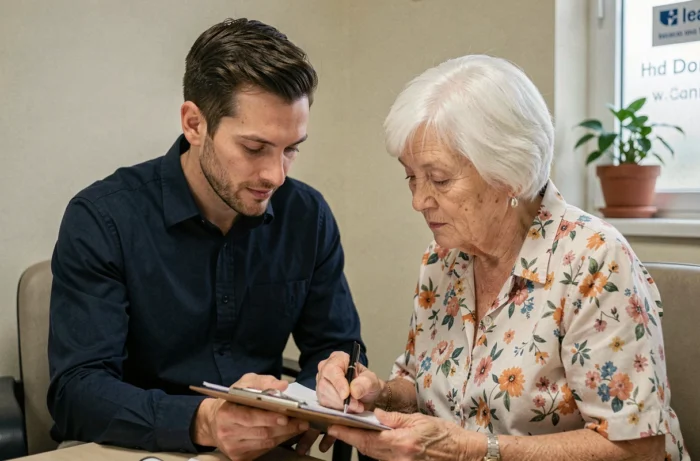
Speech therapy is not only for children. Adults consult for various reasons: rehabilitation after a stroke (aphasia), voice disorders related to intensive professional use, swallowing difficulties, or persistent stuttering since childhood.
Adult care differs in one fundamental aspect: the patient actively participates in defining their goals. A teacher who loses their voice every Friday does not have the same priorities as an aphasic patient who seeks to regain the use of simple sentences to communicate with their loved ones.
Digital tools are beginning to complement in-office sessions. Applications allow for extending exercises between appointments, with remote follow-up by the speech therapist. These supports remain a complement, not a substitute: rehabilitation relies on human interaction, real-time adjustment, and clinical analysis that only a professional can provide.
Learning to read and the role of the speech therapist in school
Unrecognized oral language disorders before entering reading create a domino effect. A child who confuses certain sounds orally will have difficulties associating those sounds with the corresponding letters. The link between phonological awareness and reading acquisition is one of the best documented in educational sciences.
The speech therapist intervenes here on a specific level: strengthening the child’s ability to break words into syllables, identify the sounds that make up a word, and manipulate those sounds mentally. This work on phonological skills differs from traditional academic support because it targets the underlying mechanism, not the reading performance itself.
When a child shows persistent reading difficulties despite appropriate teaching, a speech therapy assessment allows for determining whether it is simply a timing mismatch or a specific disorder like dyslexia, which requires structured rehabilitation over several months.
Communication and language can be worked on at every age, with approaches tailored to each patient’s profile. The first step remains the same: observe, listen, and then consult a qualified professional when the signals persist.