The saliva test detects the parent molecule, not its metabolites. This pharmacokinetic particularity conditions the entire detection window and explains why results vary so much from one individual to another, from one device to another.
Analytical thresholds of saliva tests: screening versus laboratory confirmation
The distinction between screening test and confirmation analysis is the starting point for understanding the detection duration of the saliva test. The two do not use the same technology, the same thresholds, or the same result matrix.
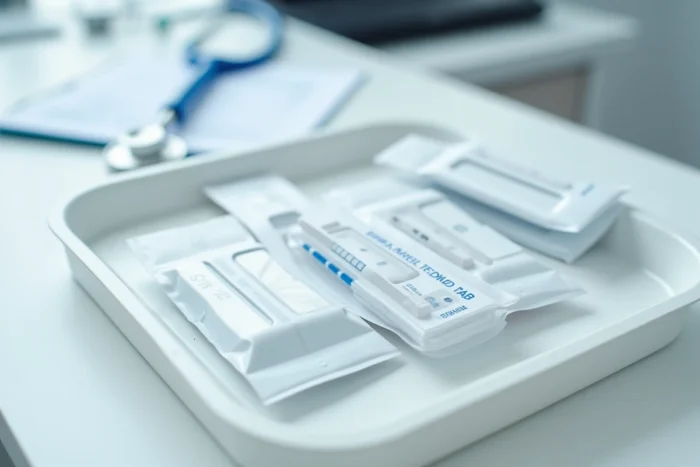
Rapid screening tests (lateral flow immunochromatography) used at the roadside operate with a positivity threshold calibrated for parent THC. This threshold, intentionally low, aims to maximize sensitivity at the expense of specificity. As a result, the test captures residual traces in the oral mucosa long after the psychoactive effects have dissipated.
Laboratory confirmation analyses rely on liquid chromatography coupled with tandem mass spectrometry (LC-MS/MS). Their positivity threshold differs, and their ability to distinguish THC from its structural analogs (such as CBD or certain synthetic cannabinoids) is significantly higher. It is on this basis that the French government has initiated the distribution of so-called confirmation saliva kits to law enforcement agencies, to strengthen the legal robustness of checks.
In practice, we observe that the relevant detection window changes depending on the type of test. A screening test may remain positive longer than a confirmation analysis on the same sample because the immunochemical threshold reacts to concentrations that LC-MS/MS considers insignificant.

Detection window of THC in saliva: pharmacokinetic variables
Saliva does not function like blood or urine. THC is present primarily through direct contamination of the oral cavity during inhalation, and then through passive diffusion from the plasma. These two mechanisms overlap, creating a biphasic concentration curve.
- The phase of direct oral contamination produces a very high saliva concentration peak in the minutes following consumption, then rapidly decreases due to mechanical effects (swallowing, natural salivary rinsing).
- The plasma diffusion phase maintains a lower but more durable residual concentration, dependent on the circulating THC level in the blood and the lipophilicity of the molecule.
- Individual salivary flow modifies dilution: a subject in a stressful situation (dry mouth) will present higher salivary concentrations than a resting subject, under identical exposure.
Single use produces a detection window significantly shorter than repeated use. In an occasional user, salivary THC drops below screening thresholds within a few hours to a day. In a regular user, accumulation in fatty tissues and gradual release significantly extend this window.
Synthetic cannabinoids and false negatives
Synthetic cannabinoids (sometimes grouped under the term “spices”) bind to the same CB1 and CB2 receptors as THC, but their chemical structures are very different. Most screening saliva tests are calibrated for delta-9-THC and do not recognize these molecules. This generates false negatives in cases of synthetic cannabinoid consumption, an angle rarely addressed in mainstream articles.
Detecting these substances requires expanded analytical panels in the laboratory. Their duration of action, often longer than that of natural THC, further complicates the temporal interpretation of results.
Workplace saliva testing: a framework that broadens the detection question
Saliva screening is no longer limited to roadside checks. The regulatory framework has expanded to the workplace, with random testing for employees and public agents in high-risk positions. Ministries have announced the organization of mandatory supervised screenings.
This change in context alters the question of detection duration. On the road, the check aims to establish a link between recent consumption and driving. In the workplace, the detection window must correlate use and job fitness, which requires a more nuanced interpretation of results.
We recommend distinguishing three situations:
- Roadside screening by screening test, whose positivity does not prove impairment of abilities at the time of the check.
- Workplace screening, which may lead to temporary unfitness and ideally requires laboratory confirmation.
- Therapeutic monitoring (patients on methadone or buprenorphine), where cross-detection between substitute opioids and illicit substances necessitates specific panels to avoid false positives.
Comparison of saliva, blood, urine, and hair: which matrix for what duration
Each biological matrix presents its own detection window, conditioned by the pharmacokinetics of the substance and the type of analysis used.
| Matrix | Detected Substance | Indicative Window | Main Use |
|---|---|---|---|
| Saliva | Parent THC | Several hours to several days | Roadside, professional screening |
| Blood | THC + metabolites | Several hours (single use) | Legal confirmation |
| Urine | THC-COOH (metabolite) | Several days to several weeks | Medical monitoring, workplace screening |
| Hair | THC incorporated into keratin | Several months | Consumption history |
Blood remains the reference matrix for legal confirmation. Saliva detects recent consumption, urine detects past consumption, hair detects long-term history. No matrix measures cognitive impairment in real time.
Technical limits and biases of current saliva tests
Toxicology experts regularly warn about the limitations of screening tests. Passive exposure to cannabis smoke can, under certain conditions (confined space, prolonged duration), generate a positive result in a non-user. This risk, documented but difficult to quantify, weakens the probative value of the isolated rapid test.
The consumption of CBD products containing residual traces of THC poses a similar problem. A legal CBD product can trigger a positive saliva test if the residual THC concentration exceeds the screening threshold, even in the absence of any psychoactive effect.
The correlation between saliva positivity and the exact moment of consumption remains approximate. Two individuals who consumed the same amount at the same time may present divergent results a few hours later, depending on their metabolism, hydration, and oral hygiene. This inter-individual variability makes any “detection duration” grid indicative, never absolute.